



Prof Mallica Kumbera Landrus
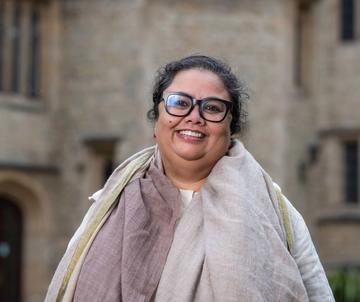
Prof Mallica Kumbera Landrus
Keeper of Eastern Art and Curator of Indian, Himalayan and Southeast Asian Art, Ashmolean Museum
Associate Professor for the History of Art in India
Fellow by Special Election
Research Summary
Mallica Kumbera Landrus is Keeper of the Eastern Art Department in the Ashmolean Museum, where the collections include ceramics, textiles, sculpture, metalwork, paintings, prints and other decorative arts, that span more than 5,000 years of cultural and artistic development, from the Islamic Middle East, China, Korea, Japan, South and Southeast Asia. Her curatorial responsibilities are mainly in the area of Indian, Himalayan and Southeast Asian art. She is a Fellow of St Cross College, Oxford.
Kumbera Landrus is an art historian and curator working on the history of art and architecture in the Indian subcontinent. Her courses and publications have focused on early modern, colonial and contemporary topics, while her curatorial projects include M F Hussain's Early Masterpieces, 1950s-70s (Brown University, 2010); Tradition, Trauma, Transformation: representation of women by Chitra Ganesh, Nalini Malani and Nilima Sheikh (Brown University, 2011); Bengal and Modernity: Early 20th century art in India (Ashmolean, 2015); Yoshida Hiroshi: A Japanese artist in India (Ashmolean, 2015); Old Traditions New Visions: Art in India and Pakistan after 1947 (Ashmolean, 2018); Ali Kazim: Suspended in Time (Ashmolean, 2022); Manisha Gera Baswani: Postcards from Home - 1947 and the Partition of India (Ashmolean, 2022/23); Soma Surovi Jannat: Climate Culture Care (Ashmolean, forthcoming 2026); Colonial Views of India: Photographs by Eugene Clutterbuck Impey (Ashmolean, forthcoming 2026).
Kumbera Landrus is on the editorial board for publication in Studies in Asian Art and Culture at the University of Bonn, and she was a Trustee of the Charles Wallace India Trust (2019-2022). Before Oxford, she was a senior lecturer at the Rhode Island School of Design (RISD). She has also held teaching, research, curatorial and/or management posts at institutes such as Princeton University, Brown University and the Jaipur City Palace Museum. In the late 1990s, Kumbera Landrus held an internship at the Smithsonian (Freer and Sackler) and was a member of the Torre de Palma excavation in Portugal, one of the largest Roman villas in Iberia. She received her PhD from the School of Oriental and African Studies (SOAS), University of London.
Research
Kumbera Landrus is interested in how material and visual culture can contribute to our understanding of global history. Her research interests focus on the Indian subcontinent, particularly with regard to the intersection of art, architecture, religion, politics and socio-economics. She is especially interested in issues of cultural translation, focusing on works and built environments created for and by colonial powers, and by emerging cultures that were themselves hybrid, transnational and diasporic.
Teaching
She has previously taught at Brown University, Princeton University, and at the Rhode Island School of Design. At Oxford, she teaches on topics such as: Trade and Exchange in Modern South Asia: Transcultural Objects, Ideas and Identities (MPhil and MSc in Modern South Asian Studies,) and Encountering South Asian Sculpture (BA History of Art). She supervises topics in South Asian material and visual culture across the Social Sciences and Humanities., and contributes lectures to various core, optional courses and seminars.
Doctoral supervision
She is happy to supervise doctoral (DPhil) research on the Ashmolean’s South Asian collection, as well as other topics in the art, architecture, and material culture of the region. She also supervises undergraduate (BA) and postgraduate (MSt; MPhil) extended essays and dissertations with a particular focus on the Ashmolean’s collections.
Featured publications
2015 Parish Churches, Colonisation and Conversion in Sixteenth-Century Portuguese Goa, in Parish Churches in the Early Modern World, ed. Andrew Spicer, Ashgate
2015 Yoshida Hiroshi: A Japanese artist in India, Ashmolean Museum, Oxford, 19 June–13 September, (Kolkata). Edited by C Pollard and M Kumbera Landrus
2015 Bengal and Modernity: Early 20th century art in India, Ashmolean Museum, Oxford, 2 March–1 June (Kolkata). Contributors: S Bhandare, M Kumbera Landrus, A Lahiri, P Mitter and P Pal
2014 Trans-cultural Temples: Identity and Practice in Goa, in In the Shadow of the Golden Age, ed. Julia Hegewald, EB Verlag, Berlin
2014 Sculptures from Kerala: Form and Performance, in Marg Publications, Mumbai
2011 Women Representing Women in Tradition, Trauma, Transformation: Representations of Women, Brown University
2010 Early Masterpieces, 1950s–70s in MF Husain, Brown University
2009 Goa: the Rome of the Orient in Baroque, 1620–1800: Style in the Age of Magnificence, eds. Nigel Llewellyn and Michael Snodin. London: V & A Publishing
2008 Catalogue entries on the Indian objects [Buddhist, Hindu, Islamic and Colonial] in Selected Works, Catalogue of the Museum of Art, Rhode Island School of Design, Providence, pp. 48–52.
2006 Portuguese Goa – Taking Ownership with Architecture, in Vanamala, ed. Klaus Bruhn and Gerd Mevissen, Wiedler Buchverlag, Berlin, pp. 97–107.
2003 Vijayanagara Art: A Political and Historical Metaphor, in Sagar 10 (University of Texas at Austin) 78–101.

